

Nutrition Label Facts
Being able to read a nutrition label is an important skill when it comes to making healthy choices. It can be challenging to make healthy choices when we are bombarded with messages online via social media, on TV, radio and in print. Even everyday coupons we see typically promote less healthy beverages and foods. After all, when is the last time you saw a coupon for broccoli?
Anyone can learn how to read a nutrition label. Remember, choosing water over sugar sweetened beverages is an easy, healthy, and less expensive choice!
Be a Label Detective
Nutrition labels provide useful information to help you make healthy food and beverage choices, but don't stop at seeing words like all natural!
Here are some key points to look at on the label:
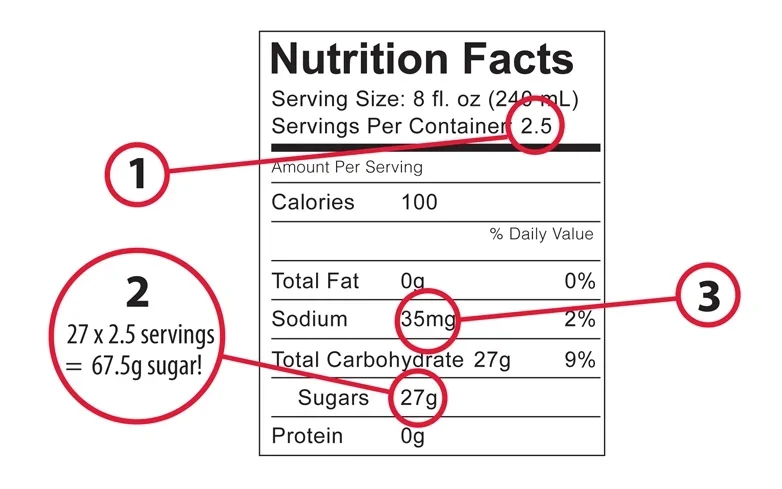
Watch the serving size. Some beverage containers actually have more than one serving. As an example, you might grab a 20-ounce bottle and assume it's one serving. The beverage company may list it as 2.5 servings. In our example (above): # servings (2.5) x sugars (27 g) = 67.5 g of sugars! It also means that what you thought was a 100 calorie drink is really 250 calories.
Sugar content is shown in grams under the Total Carbohydrates section. According to the American Heart Association, the maximum daily sugar allowance for children ages 4-8 is 12 grams. An 8-ounce glass of apple juice has around 27 grams of sugar - more than twice the recommended daily allowance.
Sodium matters, too. Most Americans get far more sodium than they need on a daily basis. Look for foods and beverages with limited or no added salt.
You can practice reading nutrition labels at home or at the grocery store. Additionally, you can practice with this interactive quiz from the FDA.
All Natural, Organic, Certified.
The front of the package may show "natural" or "organic," but that doesn't always mean it's healthy. Certain guidelines must be met to label a product as "natural" or "organic" but these food items can still be high in sugar, fat and calories. All foods and beverages in the US are required to have labeling with a complete list of ingredients and basics about the nutritional value of the product, including calories, the amount of fat, sodium, sugars and vitamins/minerals. This label will tell you much more than the pretty marketing on the front of the package.

